

Table of Contents
- The Rise & Rise of Community
- Ready to Jump In?
- Temperature of the Industry
- Community Formats for 2025/2026?
- IRL and Virtual Communities
- Why communities are important from a brand perspective
- Never Underestimate the Local Touch
- Community-First Search
- Community Signals
- Where SEO Meets Community
- Social Media Communities in 2025
- What Does This Mean for Brands?
- Platform to Watch
- Digital Communities and AI in 2025
- Community-Led Strategies and Ownership
- Authenticity and Future-Proofing
- Why Community? Boosting ROI
- Community in Action: Tesco and Vue
- Community KPIs
- More Than a Moment. It’s a Movement.
- How We Deliver Community
The Rise & Rise of Community
THE RISE & RISE OF COMMUNITY
In an age where trust, authenticity and meaningful connection matter more than ever, community-driven marketing might be the route to unlocking your most powerful results yet.
This report takes a deep dive into community in all its forms and features independent research from 250 UK CMOs, pulse checks from global marketing partners and insights from channel experts – cross sector, cross industry. This, combined with Tigerbond’s 35 years’ experience representing some of the biggest brands on the high street, has helped us to create a definitive guide to community-driven marketing.
We understand the challenges that targeting community presents but with the right integrated strategy (and partner) you can achieve mind-blowing results. A channel agnostic, data and insights driven approach upfront allows every possible combination of tactic to work in harmony to resonate with the right communities, with the right content, at the right time and through the right channels.
Inside, you’ll find everything you need to know from strategy, tactics, tools and templates with a few hacks thrown in along the way to help you nail your future community strategy.
We hope you love it.
LAURNA WOODS CEO, Tigerbond
Ready to Jump In?
What do we mean by community-driven marketing and why is it the new algorithm worth chasing?
Quite simply it’s all about really understanding where your customers and target audiences are. Putting them front and centre and engaging with them in their own communities, in real life (IRL) and online, in a highly targeted way that will transform them into brand loyalists and advocates. Used correctly, community- driven marketing is the most powerful and effective tactic in your toolkit.
The one thing every community has in common is a shared goal, belief or experience. Communities can be broad, or hyper-specific and can vary drastically in size. Almost all communities are centred around at least one of the five Ps – passion, purpose, people, profession or place. Hit the bullseye on one or more and you will unlock the key to the fandom.
Temperature of the Industry
DEFINITIVE STATS
CMOs are prioritising community. And so should you.
It’s clear that community-driven marketing is here to stay. Engagement within community groups is key to growth and brand loyalty. It’s a global trend. Tigerbond’s international network, Worldwide Partners (WPI), report community being an increasing focus for clients in the last year. Most brands are carving out budget to hit it specifically. Communities are being determined by psychographic and passion‑point segmentation and the focus has grown in recent months.
In our independently-commissioned survey with Censuswide, we spoke to 250 UK CMOs to uncover key trends for the year ahead and the strategic importance of community‑focussed marketing.
The findings reveal:
- The top benefits of community-focussed campaigns include: greater brand visibility, improved customer retention and higher engagement.
- CMOs’ top 5 priorities Boosting engagement and loyalty, increasing brand awareness, building communities, leveraging AI, and exploring new content platforms.
- 1 in 4 marketers see community and engagement as the top marketing opportunity for the year ahead.
- The biggest barrier to expanding community efforts is time and resources.
According to our partner survey... Brands and agencies are seeing higher engagement, relevance, conversion and brand lift in campaigns with a community focus.
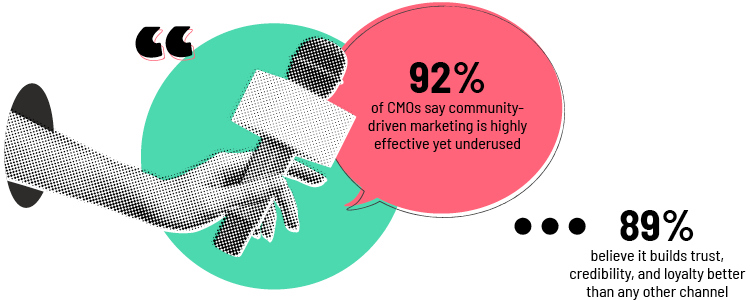
- 92% of CMOs say community- driven marketing is highly effective yet underused
- 89% believe it builds trust, credibility, and loyalty better than any other channel
Community Formats for 2025/2026?
COMMUNITY TYPES
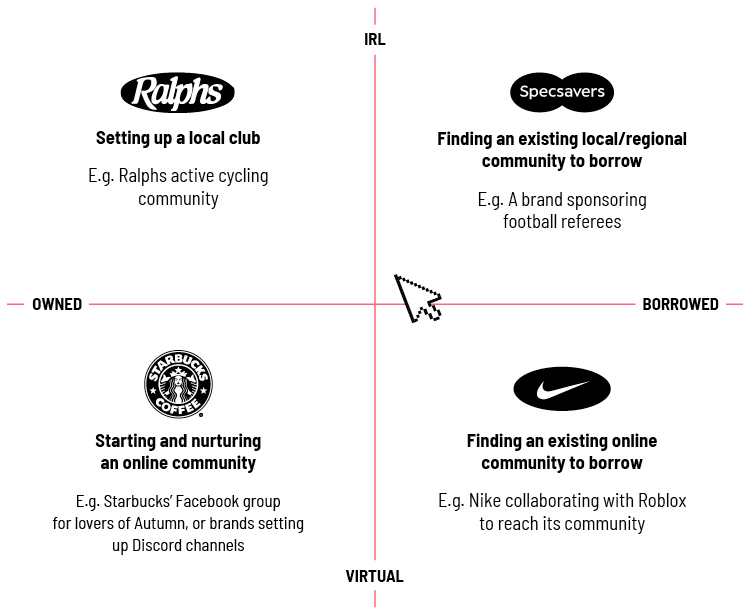
When it comes to brand marketing, communities can be defined in two ways. Firstly, by the nature of the community – is it a physical or virtual community?
IRL Communities that function offline including local and regional communities.
Virtual Communities that function online including social media, forums, metaverse.
And secondly, when engaging in community activities, brands can either choose to grow and “own” a community (Owned) or ‘borrow’ a pre-existing community (Borrowed) by engaging an influencer, finding local clubs or engaging in established forums.
ORDER OF COMMONALITY
- Virtual-Borrowed
- Virtual-Owned
- IRL-Borrowed
- IRL-Owned
NOTE Virtual communities will often spill into IRL and vice versa – but they usually originate from one or the other.
IRL and Virtual Communities
Virtual may be more prominent, but IRL runs parallel. Social networks and virtual spaces can play a valuable community role. They help people connect beyond geographic limitations and share knowledge, insight and passions. But those networks and spaces come with their own limitations.
happens offline. Physical spaces like gyms, cafés, and community places play a big role in bringing people together.
In Harvard Business Review, Mark Rosenbaum from Northern Illinois University, points out that the relationships built in these real life “third places” can offer just as much—if not more—emotional and social support than family ties. In fact, these strong community bonds can even add value, with businesses seeing up to 20% higher returns where these connections thrive. Add to this that 74% of Gen Zs, and 66% of Millennials, believe IRL experiences are more important than digital ones – and it’s apparent that there’s a real place for IRL community in the current climate.
Online interactions can feel disconnected and non- human. When people aren’t face-to-face, they are more likely to act out or behave in ways they wouldn’t in-person. So many digital connections are fleeting and surface-level, which doesn’t do much to build real, lasting relationships. And let’s not forget, real life still
CONSUMERS Why communities are important from a consumer perspective
- 76.6% of consumers wish their favourite brands had a community
- 40.9% of consumers say their involvement in online communities will increase in 2025. That’s an increase of 9% year-on-year
- 67% of consumers feel more connected through community than social media
- Involvement 88% of consumers are motivated when a brand makes them feel involved, like they are part of a team
- 73.6% of consumers are more likely to purchase more frequently because of an online brand community, an increase of 8% since 2022
- 54% of Gen Zs say that their favourite brands are the ones that make them feel like they’re part of a community
- Purchase decisions 81.6% of consumers are more likely to purchase new product varieties because of an online brand community
WHY COMMUNITIES ARE IMPORTANT FROM A BRAND PERSPECTIVE
- 75.5% of marketers agree it’s important to have two-way communication with consumers, but 1 in 4 believe their brand’s two-way consumer communication is weak
- 67.5% of marketers believe community-building is important to creating emotional loyalty
- On the rise 42% of marketers feel they don’t have cost and time efficient approaches to obtain all of the customer insights they need for their brand
The demise of third-party cookies is one of the biggest challenges marketers are facing. Community-building can help with this by supporting the collection of zero-party data
- 99.6% of consumers are willing to share some form of personal data in exchange for relevant incentives.
Zero-party data Zero-party data is data that a customer intentionally and proactively shares with a business. It can include preferences, purchase intentions, and personal context. The biggest advantage of zero-party data is accuracy. Since it’s provided by the customer, you don’t have to question the source
Brands are consistently trying to obtain new UGC and reviews, but this can often be a challenge
- 64.5% struggled to secure a large volume of video/ stories UGC
- 62% struggled to secure high quality video/ stories UGC
User-generated content Any form of content, such as images, videos, audio, text, testimonials that has been posted by users’ online content aggregation platforms such as social media, discussion forums and wikis
Community building and engagement may be the answer...
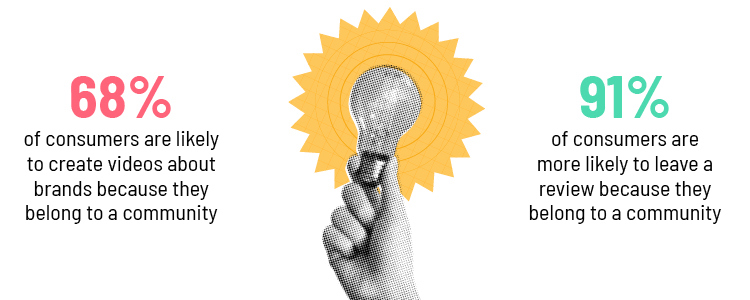
- 68% of consumers are likely to create videos about brands because they belong to a community
- 91% of consumers are more likely to leave a review because they belong to a community – an increase of 22% since 2022
Never Underestimate the Local Touch
Local media plays a vital role in engaging communities. We are seeing the way people consume content and news become increasingly fragmented and personalised. This is creating new online communities, which are shaped by the news and information ecosystems they exist in rather than where they are based geographically.
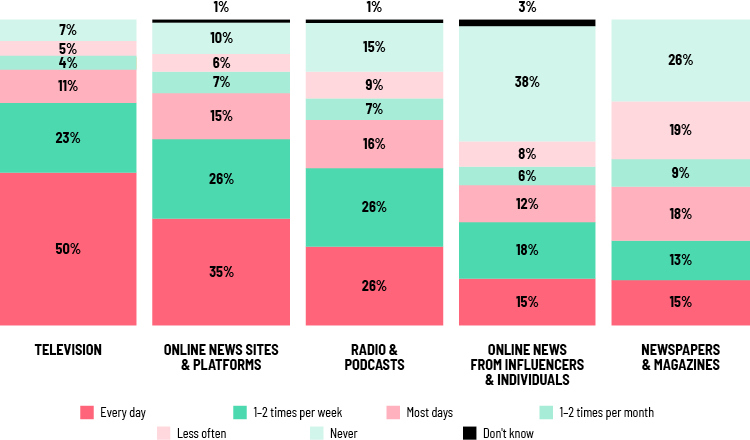
For example, podcasts are seen as even more trustworthy than online news sites, newspapers and magazines. Overall, only 31% of Brits trust online news from influencers, but this rises to almost half (47%) for those aged 16-34. Online influencers also act as the daily news source for most (55%) of those younger than 34, whereas only 34% of this age group consume news from television on a daily basis.
As a recent IPSOS survey shows, while trust in traditional news outlets remains high (especially for television) we are seeing new media having a growing impact.
How often, if at all, would you say you use, watch, read or listen to news and information on each of the following types of media?
ELLEN GRINDLEY Senior Regional News Journalist
“People want to hear from people like them who share the same streets, face the same issues, and celebrate the same wins.” “Local broadcasters aren’t distant voices from a studio based far away; they are neighbours, business owners, volunteers, and community champions. When they speak, they speak with an understanding of the issues that matter.”
ALEX WILLIAMSON Managing Partner, Markettiers
“This is the age of infinite information. We have facts, stats, knowledge and advice from the farthest corners of the globe, and yet the need for reliable local news has never been greater. People want to know about their communities, to be informed about the events and people that affect them directly – and so local media are delivering innovative strategies to connect with their audiences.”
“ In addition to websites and online editions, media outlets are using videos, social media and podcasts to engage with different demographics and diversify their delivery streams, so that they can provide breaking news updates and live coverage, keeping audiences informed in real-time. In turn, readers can comment, share stories, and participate in discussions – all of which further fosters a sense of community.”
Community-First Search
In 2025, even amidst AI noise and Google’s efforts to force generative results down our throats, the behaviour of users and their appetite for authentic over artificial isn’t being completely ignored. In fact, the reality is far from it.
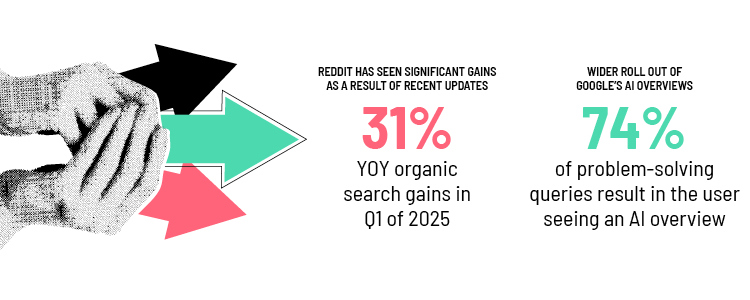
Recent evidence points to Google combating the rise of AI content bloat; where digital communities exist shows promise for the biggest impact. Reddit, for example, has seen significant gains as a result of recent updates, with: 31% YOY organic search gains in Q1 of 2025
How do you get around websites that flood the algorithm by producing poor quality, AI-generated content to climb the ranking ladder? Well (and this is precisely what Google has done) you reward the complete opposite.
Why? It is a trusted community forum and the content is completely authentic – it connects users with real human perspectives, opinions and experiences.
With the wider roll out of Google’s AI overviews: 74% of problem-solving queries result in the user seeing an AI overview
Promote the authentic over the artificial, real experiences over the drab and dull, genuine experts over the generic.
This is a major challenge to SEO specialists, content writers and anyone whose role entails driving search visibility. How do you make the information gain bigger and better than what Google’s AI offering provides in milliseconds? It all comes back to community.
“Build intrigue, make users feel part of something, enrich their lives, encourage engagement and take them on a journey with your brand. Yes, clicks might be of lower volume than your analytics has shown over the last decade, but put the vanity metrics to one side, the per-click value to your brand is infinitely more if it means establishing a real connection.”
SAM GRANT Digital Marketing Director, Tigerbond
Community Signals
Community signals – this is the sign you’ve been waiting for!
For some time, those of us that live and breathe the dark art of SEO have focussed on three core pillars to improve ranking positions, traffic and engagement: how technically sound a website’s pages are, the production of great content and offsite signals – valuable links from other websites that act as a ‘vote of confidence’ in Google’s eyes to boost rankings.
When we talk about community and its value to SEO, it’s perhaps the offsite piece that has experienced the most telling impact.
Community signals have become critical– reviews, unlinked brand mentions, and post- click engagement have become ranking factors in their own right. How do we know?
Well, Google’s 2025 Quality Rater Guidelines explicitly instruct evaluators to treat “customer reviews as reputation” information. While Google previously leaned into links as its defining signal of authority, this is now much more complex.
It’s about how your brand is presented, talked about and engaged with in the digital space that really matters.
Links are still of value, especially when explicitly relevant to your product or service and your target community, but digital marketers should now think much bigger.
Think brand building.
Where SEO Meets Community
Google’s 2024 addition of ‘experience’ as the extra E in the E-E-A-T framework (Experience, Expertise, Authoritativeness, and Trustworthiness) is clear evidence that search now rewards signals that come from users not just those coming from content created for them.
1. We know that offsite signals like mentions, reviews and engagement directly influence rankings. As a result, SEO teams should work more closely with PR teams to roll out integrated strategies that deliver viral campaign coverage across media outlets that align to target audiences, create noise and deliver engagement.
Looking closer at the 2025 Quality Rater Guidelines, there is instruction to “treat customer reviews as reputation information”, with weight placed on volume, detail and sentiment alongside the existing review of content quality.
2. Brands should consider genuine immersion in community platforms like Reddit. Identify and participate in relevant threads (where it can be justified) to deliver authentic, additional value to the community, encouraging continuation and content enrichment.
Brands must develop trust with their audience through authenticity and build authority through organic mentions of their business, which confronts SEO managers with a new challenge. Either through their own activity or via mobilisation of their communities, how do brands create and engage with the communities in a way that drives SEO gains?
3. A solid review strategy! BrightLocal’s 2024 study found:
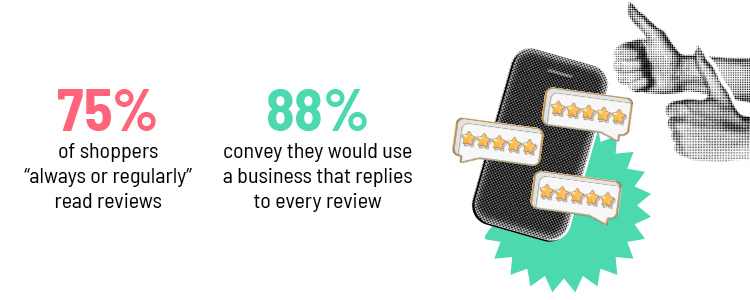
75% of shoppers “always or regularly” read reviews, with 88% of respondents conveying they would use a business that replies to every review The collection and replying to of reviews on both website and on offsite platforms should form a central part of a brand’s SEO and digital reputation management strategy.
4. Leveraging of testimonials, Q&As and lived experiences with your brand (and search engines through mark-up) deliver the proof, rendering users more likely to engage in influencing other ranking factors and driving visibility.
Social Media Communities in 2025
THE LANDSCAPE
Social media has become the most obvious community-building channel – it allows brands to connect with large groups of customers across geographies, interests and demographics.
CONNECT WITH MY COMMUNITY
But, one of the major shifts in the social media landscape has been the fragmentation of “social” and “media”. Taking the lead from TikTok, many platforms have evolved into media-first experiences: prioritising entertainment and discovery. Hyper-personalised algorithmic feeds are designed to keep users scrolling, but don’t always encourage social interaction or human connection.
Meanwhile, much of the “social” aspect of social media has splintered off into what’s been coined “dark social” — the private and semi-private spaces like direct messages, group chats, and forums. It’s estimated that:
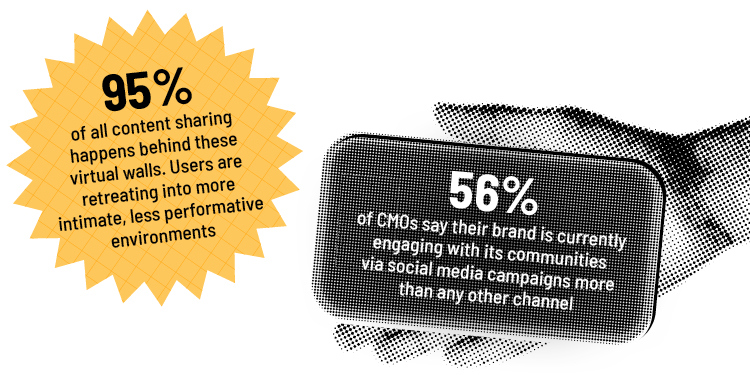
- 95% of all content sharing happens behind these virtual walls. Users are retreating into more intimate, less performative environments
- 56% of CMOs say their brand is currently engaging with its communities via social media campaigns more than any other channel
What Does This Mean for Brands?
It means that for brands to build brand fans they have two jobs to do – drive community visibility and prioritise community nurturing.
1. Community Visibility
This is the outward-facing part of your strategy: creating content designed to resonate with – and be discovered by – specific communities. The rise of interest-based recommendation algorithms means brands no longer need to chase broad reach. Instead, they can focus on cultural relevance, making content that speaks directly to a niche audience’s values, humour, language, and habits.
These communities might not gather in one defined space, but they signal themselves through shared behaviours and content trails. Whether it’s “#BookTok” readers or passionate ‘#PlantTok’ plant parents, interest-based subcultures thrive across platforms. Brands that contribute value and speak the community’s language can earn organic visibility – not by forcing their way in, but by becoming a valued participant.
To engage the #BookTok TikTok community, American bakery-café Panera Bread partnered with creators to produce cosy café reading content – complete with warm drinks, soft music, and slow shots of books in quiet corners. The kind of dreamy, soothing content that performs well in BookTok’s cosy sub-genres. Rather than promoting menu items, the brand focussed on aesthetic, mood-driven storytelling. It worked because Panera signalled to the community that it understands that #BookTok isn’t just about reading - it’s about the environment, lifestyle and identity that surrounds it.
2. Community Nurturing
Visibility is only the first step. Once people find and connect with your brand, nurturing that connection in more intimate environments is essential. This is where many brands fall short – they stop at content creation and neglect to build spaces where their communities can deepen their relationships. This is where trust and loyalty are built.
Fitness powerhouse Peloton’s approach to community nurturing is built on lightly moderated, member- led Facebook groups - with hundreds of thousands of participants who motivate, support, and celebrate one another. While Peloton occasionally guides discussion or shares exclusive content, they largely let the community take the lead. It’s a subtle but confident and powerful approach: Peloton hosts the space, but doesn’t dominate it.
Community nurturing means creating semi-private or exclusive environments where your most engaged audiences can interact – not just with you, but with each other. This could be a members-only group, a dedicated chat thread, an insider club, or even a recurring livestream or audio hangout. What matters most is that the space feels reciprocal and meaningful – the users want to feel like they are part of something.
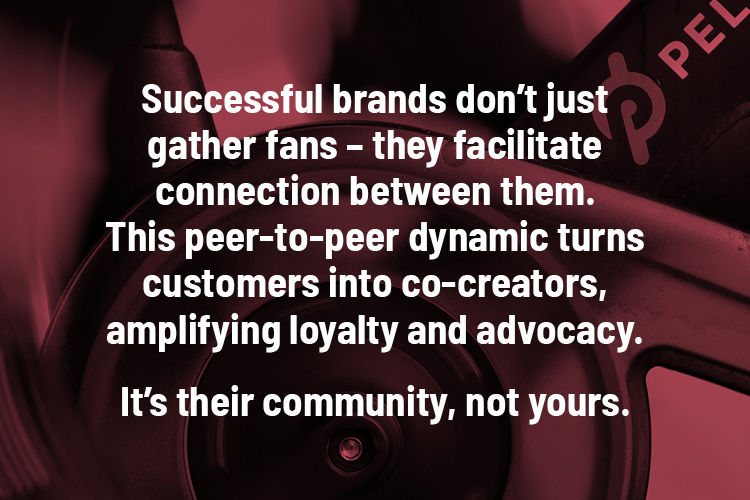
Successful brands don’t just gather fans – they facilitate connection between them. This peer-to-peer dynamic turns customers into co-creators, amplifying loyalty and advocacy. It’s their community, not yours.
Platform to Watch
“In an increasingly fragmented social landscape, community is the glue. Yes, algorithms can help you reach niche communities, but they won’t help you foster community spirit. Brands that balance visibility with intimacy, who show up with relevance and stay with intent, are the ones that will build real loyalty in 2025 and beyond.”
BRYAN ARMIT Head of Social, Tigerbond
PLATFORM TO WATCH
Substack is a key platform poised to benefit from the shift toward more intimate, interest-led online communities. What began as a newsletter platform for writers and creators has rapidly evolved into a multifaceted social space. It now offers a Twitter-style text and image feed, short-form video, and long-form articles and newsletters.
Substack stands apart from other platforms in a few important ways:
- It fosters community. Newsletters are often centred around niche interests (from chocolate obsessives to hardcore language learners). But these aren’t typical one-way newsletters. Substack enables comments and discussions, encouraging interaction between readers and allowing communities to form and flourish around shared passions
- It encourages long-form deep dives. This format naturally supports and strengthens community. Members who care deeply about a topic are more likely to seek out thoughtful, in-depth content vs. short, surface-level posts. Substack gives space for this kind of rich exploration, feeding a more meaningful and sustained form of engagement
- It incentivises community building. Users can subscribe to the writers, collectives, or communities they feel most aligned with. Paid subscriptions unlock exclusive content, creating a direct value exchange. This not only supports creators financially, but also motivates them to keep producing relevant, community-led content
Digital Communities and AI in 2025
The future of community is unfolding before us, and AI is at the forefront, shaping how we connect in ways that are both innovative and challenging.
While AI-driven tools are revolutionising marketing by enabling faster and cheaper content production, they are also making content feel increasingly generic, samey and lacking a creative, human touch. In a sea of AI-generated copy, brands risk losing their unique voice and run the risk of blending in rather than standing out.
This shift has brought about a new reality: human connection now stands out where AI content falls short. People naturally gravitate towards authentic, relatable voices, quickly recognising the difference between a genuine perspective and something that feels machine-made.
As brands continue to automate, adopting community-led strategies becomes crucial to maintaining credibility and fostering meaningful engagement.
COMMUNITY-LED STRATEGIES BUILD TRUST IN THE AGE OF AI
In a landscape crowded with AI- generated content, the challenge for brands is to resonate on a human level. Word-of-mouth, user-generated content, and peer reviews, are increasingly gaining traction because they feel real and trustworthy.
People trust other people, not algorithms. In a world where AI is automating interactions and messaging, communities offer something AI simply cannot: real and real-time opinions, shared experiences, and trusted voices.
“With increasing digital fatigue and economic pressure, people are leaning into trusted, relevant networks. Brands that connect meaningfully within communities are rewarded with loyalty, word-of-mouth advocacy, and contextual relevance.”
CLANCY MCMAHON Digital Director, Tigerbond
OWNING YOUR DIGITAL COMMUNITY MATTERS
The digital marketing landscape is becoming increasingly volatile and platform algorithms are being inundated with AI-generated content, leading to content saturation and making it harder for authentic voices to stand out. Moreover, rapid changes and unpredictable algorithm updates mean that relying solely on social media is no longer a sustainable engagement strategy.
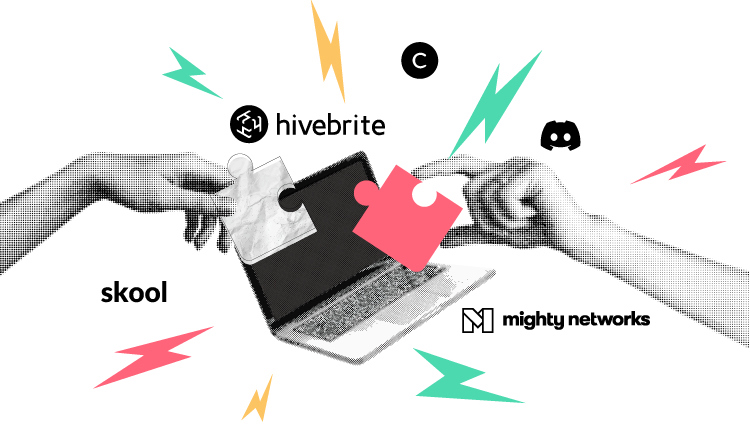
Key platforms that enable brands to build and manage their own communities include Mighty Networks, Circle, Skool, Discord and Hivebrite.
These platforms offer customisation options, community management tools, and data ownership, allowing brands to cultivate authentic and controlled environments. Additionally, brands can leverage Slack and Discord for more conversational and real-time engagement, while Patreon and Substack facilitate content-driven community models where users can actively support creators.
Brands are moving away from dependence on external networks where visibility can change overnight. Instead, they are investing in building their own digital communities, creating stable, owned spaces that allow for consistent engagement and storytelling, free from the algorithmic whims of mainstream platforms.
Community-led strategies not only break through the monotony but also create deeper, more personal connections.
Authenticity and Future-Proofing
PROCEED WITH CAUTION – AUTHENTICITY MATTERS
While building a proprietary community platform offers strategic advantages, it’s crucial to approach it authentically.
Efforts to create or engage with digital communities shouldn’t feel like a branded echo chamber or a thinly veiled marketing effort. If interactions appear forced or inauthentic, disengagement or backlash is likely to follow. This is Web 2.0 in action – platforms like Reddit, for instance, thrive on unfiltered, real-time feedback, meaning brands must be prepared to navigate open criticism and genuine discourse.
FUTURE-PROOFING THROUGH COMMUNITY OWNERSHIP
The key lies in fostering organic growth – creating spaces where authentic conversations can flourish and where members feel valued rather than marketed to. A successful community balances brand presence with the freedom for members to express themselves openly and honestly. Any attempt to over-control or curate interactions risks alienating the very audience the community aims to attract.
Investing in a dedicated community platform isn’t just a reactive measure against the unpredictability of social media. It’s a proactive step towards future-proofing a brand. As digital platforms continue to evolve, owning a stable space ensures that your audience always knows where to find you. Additionally, it secures your data and your ability to directly engage with your community without third-party interference.

Why Community? Boosting ROI
No vanity metrics here. Targeting communities can’t be broadbrush. Campaigns and activations that speak directly to communities deliver the best ROI, there’s no wastage. ROI is about genuine impact and engagement with a community group, however that’s defined.
We know this because we see it in the work we do...
Community in Action: Tesco and Vue
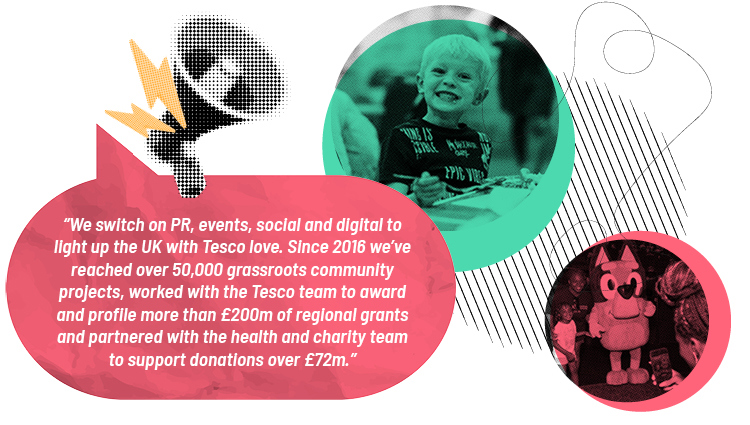
“We mobilise our tiger teams rooted in the UK’s key towns and cities to launch and spread the word about Tesco’s key community initiatives, bringing the retailer’s purpose to life. We switch on PR, events, social and digital to light up the UK with Tesco love. Since 2016 we’ve reached over 50,000 grassroots community projects, worked with the Tesco team to award and profile more than £200m of regional grants and partnered with the health and charity team to support donations over £72m.”
“As agency partners for more than a decade, our aim for Vue is to get fans and potential customers from all corners of the UK and Ireland into Vue venues over the competition. The ‘community’ is wide and changes every single day based on the films available – we’re always ready to leverage our channels to tap into each audience, everywhere. Amazing content, in the right place, at the right time and importantly seen by the right people. We work with Vue to ensure no stone is left unturned and ideas and activations are stretched as far as possible. Vue regularly remains the number one cinema brand in the UK in terms of market share, we’re generating 750 pieces of coverage leading to real ROI in terms of admits, 680,000 influencer engagements and a regular roll out of site openings and refurbs.”
LUCY COUGHLAN PR Director, Tigerbond
Community KPIs
Community campaigns should always start with a channel agnostic approach.
Establishing the insight first to set the strategy defines what should be reported on
It may not be traditional metrics at all. At Tigerbond we have a live reporting method which enables us to measure and adapt in real time. We’re able to see what communities are engaging with and reacting to and can therefore upweight and downweight activity and tactics accordingly.
ROE (Return on Engagement) should be tracked alongside ROI. Activity, reach and value of interactions within a community – through sharing, engaging and participation – leads to sales uplifts, increased brand tracking scores and advocacy. According to Loyalty Lion, on average, brands see a 1,352% ROI within two years of establishing strong customer communities and this can increase to as much as 10,000% after 10 years.
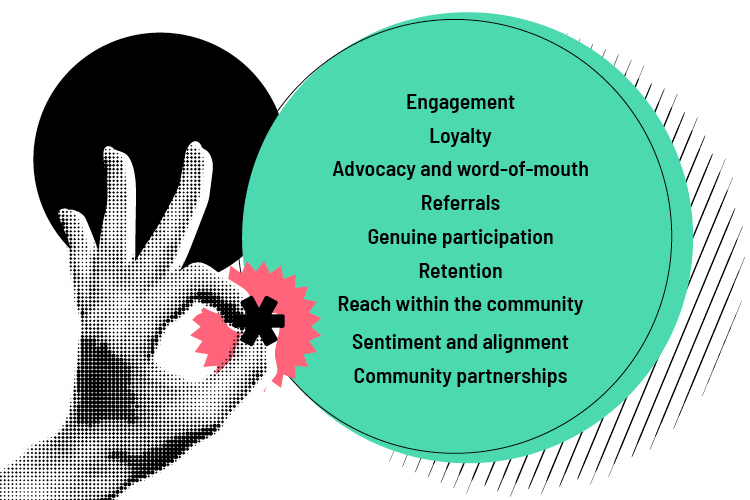
KPI considerations, depending on brand campaign goals, could include:
- Engagement – footfall, clicks, participation, visits – Loyalty – Advocacy and word-of-mouth – Referrals – Genuine participation – Retention – Reach within the community
- Sentiment and alignment – Pulsar insight on real conversations
- Community partnerships formed
More Than a Moment. It’s a Movement.
JOANNE SPENCE Co-founder, Tigerbond
MORE THAN A MOMENT. IT’S A MOVEMENT.
If you take anything from this report, it’s this: community-driven marketing is here to stay. It’s not a trend, it’s a cultural shift that audiences no longer expect but demand.
ground activations. Loyalty, advocacy and emotional connections are all leveraged through the power of community so, value it and it will help drive long-term growth. The time and effort you put in now to building your community strategy will be the best investment you can make for future-proofing your brand.
Before we go, we want to leave you with one last thought.
It’s also a strategy where everyone wins – brands and consumers. Nurture, invest, listen and act on what your communities tell you. Let the community signals guide you. Watch the real magic happen when you connect digital activity with real-world, on-the-
Think of a brand you love. Why do you love it? Think about what they do to make you feel special and part of that brand. Why do you stay loyal?
TRUST. EXPERIENCE. BELONGING.
It begins and ends with community.

How We Deliver Community
Or better still, come meet us for a coffee IRL in Glasgow, Manchester, Leeds or London. HOW WE DELIVER COMMUNITY
We’re an agency at the heart of community. Living and breathing it in every sense of the word – IRL and online.
We are plugged into the communities where we work, live and play. We have a full-house, in-house and combine real-world insight with our tech stack to create strategies that deliver impact.
A place where big agency thinking meets local and cultural relevance, we make national brands and organisations relevant through our community lens.
If you’d like to find out more about community- driven marketing or how we could help develop your community strategy, email us at community@tigerbond.com
or drop us a DM on
References
References
- Attentive: New Global Study Reveals Consumers Demand More Personalization in Marketing; 81% Ignore Irrelevant Messages, While Personalized Experiences Drive Loyalty and Sales | Press Releases
- BrightLocal: Local Consumer Review Survey 2024: Trends, Behaviors, and Platforms Explored - BrightLocal
- Censuswide: https://charts.censuswide.com/ J15123CWRS/J15123CWRS_VIbox.html
- Harvard Business Review: https://hbr.org/2009/04/ getting-brand-communities-right
- Hootsuite: Social Media Trends 2025 | Hootsuite
- Ipos: Half of 16–34-year-olds trust news from online influencers, even with concerns about ‘widespread fake news’ | Ipsos
- Khorors: 9 benefits of online communities for brands | Khoros
- Mailchimp: Dark Social: The Hidden Side of Online Traffic | Mailchimp
- Search Engine Journal: Google AI Overviews Found In 74% Of Problem-Solving Queries
- Search Quality Evaluator Guidelines: searchqualityevaluatorguidelines.pdf
- SEMRush: http://semrush.com
- Terakeet: Death of Third-Party Cookies (What Marketers Need to Know)
- Tintup: Big List of Community Powered Marketing Stats - TINT
- Voguebusiness: Vogue Business: Fashion Industry Expertise From an Insider’s Perspective | Vogue Business
